The material your camera pole is made from decides how long it lasts in saltwater, and how steady your footage looks while it is under.
Saltwater is one of the harshest environments any gear faces, and a camera pole spends its whole working life dipped straight into it. Get the material right and the pole shrugs off years of fishing, boating and reef work. Get it wrong and the sections seize, the fittings corrode, and the whole thing fails within a season. So before you buy, it helps to understand what marine grade really means, how the common materials hold up, and why the choice matters more than the price tag. In short, this guide walks through the main pole materials, the galvanic corrosion trap that catches cheap poles, how to care for a pole in saltwater, and which option holds up best.

What marine grade actually means
Marine grade is not a sticker you can trust on its own. Instead, it describes a whole system built to survive salt, not just one part. A truly marine grade camera pole combines a corrosion resistant tube, fittings and hardware that resist chloride attack, clamps and locks that seal out grit and rinse clean, and materials chosen so they do not corrode each other when wet. Miss any one of those and the weakest link decides how long the pole lasts. So the tube material matters, but so do the screws, clamps and mount around it.
How camera pole materials compare in saltwater
Here is how the common pole materials stack up once salt gets involved.
| Material | Saltwater corrosion | Weight | Stiffness (less flex) | Marine verdict |
|---|---|---|---|---|
| Carbon fibre | Immune, non-metallic | Very light | Excellent | Best all round |
| Aluminium (anodised) | Pits once the coating is scratched | Light | Good | Okay with regular care |
| Stainless steel (316) | Strong, but can still crevice corrode | Heavy | Excellent | Durable but heavy |
| Fibreglass | Immune | Medium | Moderate | Budget friendly |
| Plastic or nylon | Immune | Light | Poor, flexy | Light use only |
Carbon fibre is non-metallic, so it simply cannot rust or pit, no matter how long it sits in salt water. On top of that, it is remarkably light and stiff, which keeps a long pole steady rather than wobbly once it is extended underwater. Steadier footage is the direct result. Its main caveats are cost and care, since the outer resin can degrade under constant UV unless it is coated, and carbon breaks cleanly rather than bending if you badly overload it. For camera loads, though, those limits rarely come into play.
Aluminium is light and affordable, and it bends rather than snaps, which some people prefer. However, salt water is unforgiving on it. Anodising protects the surface, yet a single scratch exposes bare metal that then pits and corrodes. Over time an untreated aluminium pole can go chalky and its clamps often seize. With regular freshwater rinsing it can still work, but it asks for far more maintenance than carbon.
Marine grade 316 stainless steel earns its name thanks to added molybdenum, which resists the chloride pitting that eats cheaper 304 stainless. It is tough and stiff. The trade-off is weight, because a stainless pole is heavy to hold at full reach for any length of time, so it suits fittings more than full length tubes. Even 316 can suffer crevice corrosion in trapped, oxygen starved spots, so it still needs rinsing.
Fibreglass and plastic both dodge corrosion entirely, which makes them cheap and low maintenance. The catch is stiffness. Both flex far more than carbon, so a long fibreglass or plastic pole bounces and sways underwater, and that movement shows up in your footage. They are fine for short reaches and light use, but they struggle as poles get longer.
The galvanic corrosion trap
One failure mode catches out cheaper poles more than any other: galvanic corrosion. When two different metals sit together in salt water, they form a tiny battery, and the less noble metal corrodes faster to protect the other. So an aluminium section joined with plain steel hardware will quietly eat itself around the fittings. Carbon fibre adds a twist, because carbon is electrically noble, so any bare metal part touching it can corrode faster than it would on its own. Good marine poles handle this by using compatible marine grade fittings and isolating dissimilar materials with plastic washers or sleeves. Therefore, when you assess a pole, look as closely at the screws, clamps and mount as you do at the tube.

Caring for a camera pole in saltwater
Whatever material you choose, a little care goes a long way. After each session:
- Rinse the whole pole in fresh water with the sections extended, to flush salt out of the clamps.
- Drain and dry each section before you collapse and store it.
- Check and occasionally lubricate the locks so grit does not seize them.
- Avoid adding cheap dissimilar-metal accessories that invite galvanic corrosion.
Do this consistently and even a hard working pole will last for years.
Where marine grade camera poles are used
A marine grade pole earns its keep anywhere you need eyes below the surface without getting in the water. Common uses include:
- Fishing: dropping the camera beside structure, bait or a school to see what is holding down there before you cast.
- Boat and hull inspections: checking hulls, props, anodes and mooring lines from the dock, without lifting the boat or getting wet.
- Commercial marine inspections: checking installs, moorings, pylons, pontoons and marine infrastructure during builds and routine maintenance, without sending a diver down for every look.
- Marine research and surveys: monitoring reef, seagrass and marine life from the surface with minimal disturbance.
- Aquaculture: inspecting nets, pens and stock quickly and often.
- Diving and snorkelling: scouting a site or checking conditions from above before you commit to a dive.
- Swim coaching: filming stroke and technique from above the water in the pool, so coaches and swimmers get instant feedback.
- Search and recovery: locating gear or objects in murky water from a boat, dock or pontoon.
In most of these, the pole reaches into saltwater again and again, which is exactly why the material has to hold up.
Why Seavu poles are built for saltwater
Seavu poles exist for a simple reason. We went looking for a camera pole that could truly handle saltwater, and it did not exist, so we designed our own. Everything below comes from that, built for the ocean from the ground up rather than adapted from a pole made for dry land.
Seavu poles are designed specifically for marine and underwater use, and that shows in the materials. Rather than relying on one material, each pole uses the best option for every part, so the whole thing stays corrosion resistant, stiff and steady at reach:
- Carbon fibre and high strength composite sections: light, rigid and corrosion proof, so the pole holds a camera steady without flex.
- Powder coated, marine grade aluminium components: a protected, salt resistant finish where metal parts are needed.
- Stainless 316 hardware: the bolts, springs and the joint in the angled pole, chosen to resist chloride corrosion and to sit safely against carbon.
That combination is marine grade in the truest sense, with the right material in the right place and dissimilar metals handled properly. Each pole also ships with the Seavu Pole Mount, ready to connect securely to the rest of your setup. You can see the full range on our marine camera poles page, which covers the reach options below:
- Seavu 1.5m Travel Pole: best for portability, kayaks and quick checks.
- Seavu 3m Telescopic Carbon Fibre Pole: the best all round choice near the boat.
- Seavu 4.2m Angled Carbon Fibre Pole: an angled tip to aim the camera where a straight pole cannot, ideal for looking under structure.
- Seavu 6m Telescopic Carbon Fibre Pole: extra reach while staying manageable.
- Seavu 10m Telescopic Carbon Fibre Pole: deeper positioning and wider coverage.


Live view poles: the Seavu Seeker Pole Kit
A pole gets the camera into position, but it cannot solve one thing on its own. WiFi and Bluetooth do not travel through water, so no action camera can stream a live view once it is submerged. That is where a live view pole comes in.
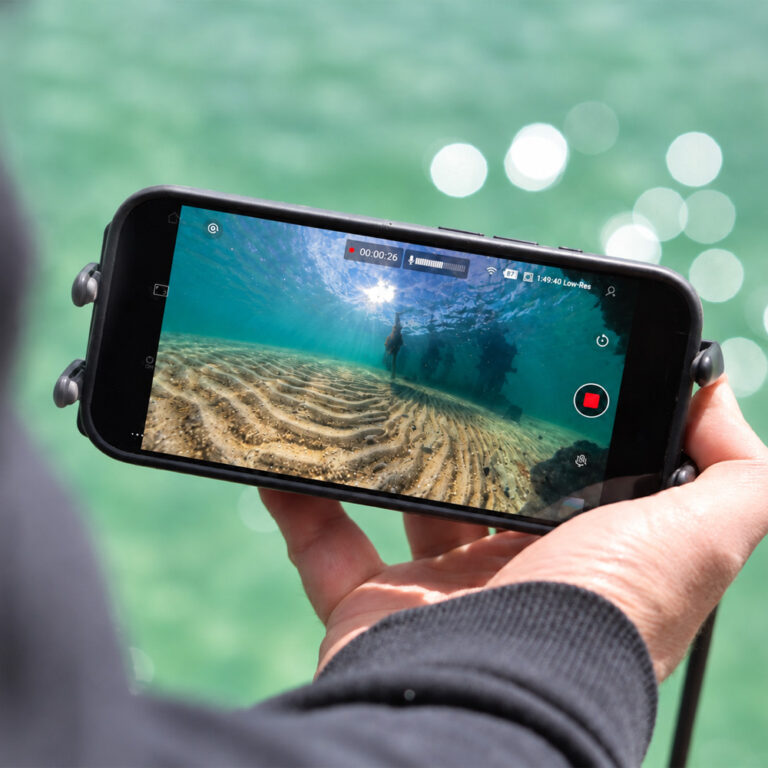
The Seavu Seeker Pole Kit combines a marine grade carbon fibre pole with the Seavu live view system in a single package. Instead of guessing what the camera sees, you watch the feed on your phone or tablet in real time while the pole holds the camera below the surface. So you can aim, frame and react on the spot, whether you are checking a reef, inspecting a hull or lining up a fish.

Because the whole kit is built for saltwater, the pole, mount and fittings all resist corrosion, so the live view advantage does not come at the cost of durability. If you already own a pole, the Seavu Seeker Marine Kit adds the same live view to your existing setup.
For camera-specific advice, see our guides to the best DJI extension pole for fishing and the best GoPro extension poles for fishing.
Bottom line
In saltwater, material is everything. Aluminium, fibreglass and plastic all have their place, but each trades away corrosion resistance, stiffness or durability somewhere. Carbon fibre, paired with marine grade fittings and a simple rinse-and-dry routine, gives you the best mix of corrosion resistance, low weight and rigidity for a camera pole that lives in salt water. So choose the material first, care for it properly, and the pole will keep earning its place on the boat for years.
Best material: Carbon fibre, for corrosion resistance, low weight and stiffness
Watch out for: Galvanic corrosion at the fittings, UV on coatings, and clamps that trap salt