How to Get a Live Underwater Video Feed
Action cameras are widely used for capturing underwater footage, but getting a live video feed while the camera is submerged is a different challenge altogether. Wi-Fi and Bluetooth normally allow real-time preview above water, but they stop working almost immediately once the camera goes underwater. This happens because water rapidly absorbs high-frequency wireless signals, a well-documented limitation explained by electromagnetic absorption in water.
We cover this limitation in more detail in our guide on why Wi-Fi and Bluetooth don’t work underwater.
So, how do you actually see what your camera sees, live, while it’s underwater?
Whether you’re fishing, observing marine life, inspecting underwater infrastructure, or live streaming an event, this guide explains the practical ways to achieve a real-time underwater video feed. It covers both tethered live-view systems and professional wired solutions.
Tethered Live Underwater Video Feed Using Wi-Fi and Bluetooth
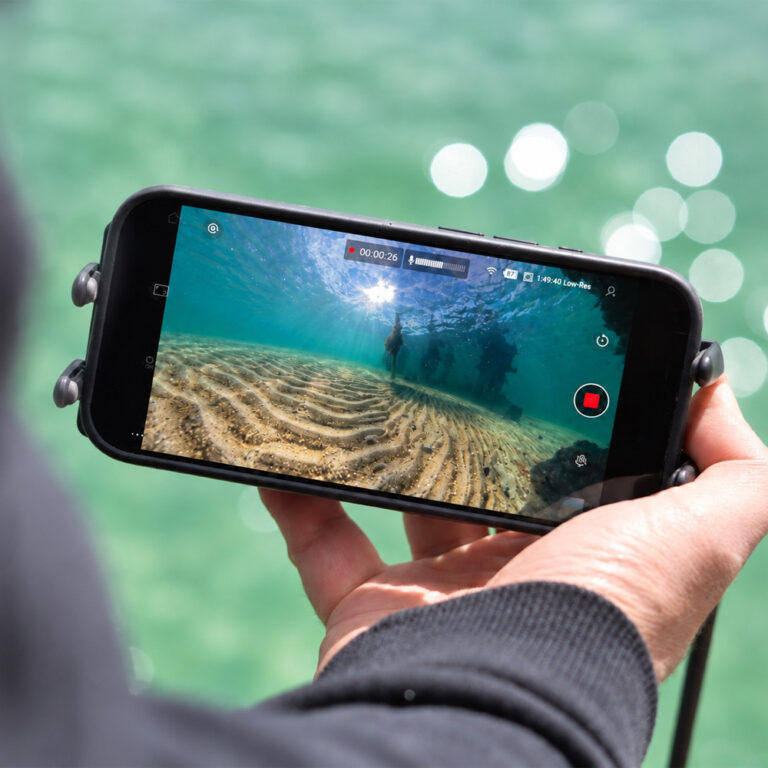
For portable and recreational applications, tethered live-view systems provide a practical way to see underwater footage on a phone or tablet using the camera’s native app.
Seavu’s Seeker and Explorer kits are designed around this tethered approach, allowing live underwater viewing without relying on wireless signals travelling through water.

How it works
- The action camera is placed inside a sealed underwater housing.
- A receiver integrated at the camera end captures the camera’s Wi-Fi and Bluetooth signals.
- A marine-grade tether cable carries the signal to the surface.
- At the surface, a transmitter relays the feed to your phone or tablet.
- Live footage is viewed using the standard GoPro or DJI mobile app.
Although Wi-Fi and Bluetooth cannot travel through water on their own due to rapid signal absorption (electromagnetic absorption in water), the tethered cable maintains the camera’s native Wi-Fi and Bluetooth connection by carrying the signal to the surface, enabling real-time underwater viewing.
Key benefits
- Lightweight and easy to deploy
- Compatible with popular action cameras such as GoPro and DJI
- Uses your existing phone or tablet as the display
- Well suited to fishing, exploration, marine research, and mobile filming
This approach offers a balance between portability and live viewing capability, making it ideal where ease of setup and mobility are more important than maximum video quality.
Wired Live Underwater Video Feed for Professional Applications
For applications that require high-quality, low-latency, or continuous live video feeds, such as inspections, marine research, or live production, a wired video connection is the preferred solution.
Rather than relying on wireless signals, these systems output video directly from the camera using DisplayPort over USB-C.
As a result, they can send uncompressed video to monitors, TVs, or capture cards at the surface.

DisplayPort output on action cameras
A wired DisplayPort connection sends video straight from the camera to a display, so the feed is not affected by wireless signal loss underwater. It suits fixed setups with dedicated surface equipment, such as long inspections, research stations and live production.
The DJI Action 5 Pro and DJI Action 6 are currently the only action cameras that support native DisplayPort output, making them uniquely suited to professional underwater monitoring and production workflows.
DisplayPort output provides several key advantages:
- Direct, uncompressed video output
- Stable, low-latency monitoring
- Seamless integration with external displays, capture cards, and live production systems
By comparison, GoPro cameras rely on wireless preview for live viewing and do not support native DisplayPort video output. Some GoPro models can output video using the Media Mod accessory via a mini HDMI connection. However, this connection carries video only. The camera still requires a separate cable or port for power, which makes this approach less suitable for professional live underwater applications.
Viewing a tethered feed on a bigger screen
For most users, a tethered live-view system is simpler than a wired video setup. If you want the feed on a TV or monitor, the Wireless HDMI Display Adapter mirrors your phone or tablet to any screen with an HDMI input, so everyone on board can watch the live preview.
Final Thoughts
Getting a live underwater video feed is no longer limited to specialised research teams or film crews. Today, there are practical solutions for a wide range of applications, from recreational use through to professional production.
Tethered live-view systems are ideal when portability and ease of use are key. Wired DisplayPort systems are better suited to situations where image quality, stability, and continuous operation are critical.
Seavu’s range of underwater camera systems uses the tethered approach, with options for fishing, inspections, research and diving, and big-screen viewing through the Wireless HDMI Display Adapter.
Ready to See Underwater in Real Time?
Explore Seavu’s purpose-built systems for getting a live video feed from your action camera underwater. Whether you need a compact mobile setup or a system for longer deployments and bigger screens, there’s a Seavu kit designed to suit your needs.