Underwater Camera Housing Depth Ratings Explained

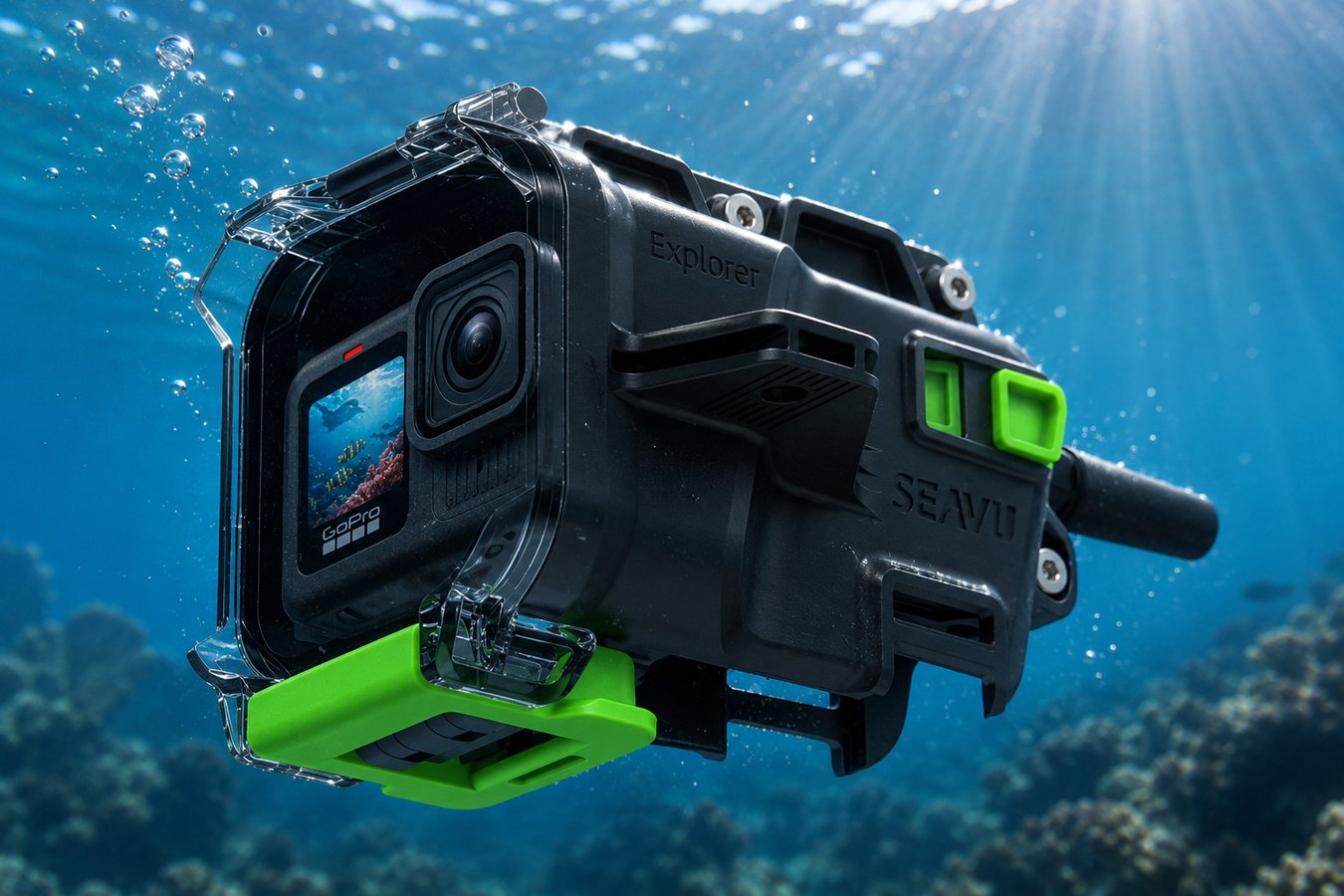
Seavu Explorer waterproof camera enclosure ready for a dive

How to read depth ratings, choose the right housing for your dive, and avoid the mistakes that actually cause leaks.

Depth ratings are one of the most misunderstood parts of underwater camera housings. Whether you’re comparing a $40 phone case to a $400 dive housing, the underwater housing depth rating printed on the box rarely tells the full story.

A housing rated to 60m does not mean it should be pushed to 60m every time you use it. A camera that is waterproof to 10m is not the same as a proper dive housing. And a housing that passes a test when it is brand new may not perform the same way after years of saltwater, sand, knocks and worn seals.

The simple rule is this: choose a housing with more depth rating than you actually need.

A shallow waterproof rating may be enough for swimming and snorkelling. For scuba diving, a dedicated housing rated to 40m or 60m is usually a much safer choice. Technical diving, professional filming or deep underwater work calls for stronger housings rated to 100m or more.

This guide explains what underwater camera housing depth ratings actually mean, how manufacturers test them, and how to choose the right rating for your activity.

What an Underwater Housing Depth Rating Actually Means

An underwater housing depth rating tells you the maximum water pressure the housing can withstand under specific test conditions.

As you go deeper underwater, pressure increases. That pressure pushes against every part of the housing, including the body, lens port, buttons, latches, hinges and seals.

For example, a housing rated to 60m can handle the pressure at that depth. However, this does not mean you should use every 60m housing at 60m all the time.

Depth ratings usually assume the housing is:

  • New or in excellent condition
  • Properly closed
  • Clean and free from sand or hair
  • Used with undamaged O-rings
  • Used as intended by the manufacturer

A housing that has taken drops and scratches, spent years in saltwater, or trapped sand in the seal may not perform like a new test sample.

Saltwater is also slightly denser than freshwater, which means it creates slightly higher pressure at the same depth. The difference is small, but it is another reason to avoid pushing any housing right to its limit.

Practical takeaway: treat the underwater housing depth rating as the upper limit, not your normal working depth.

How Manufacturers Test and Certify Depth Ratings

Manufacturers usually test underwater camera housings in controlled pressure environments, using a pressure chamber to simulate the water pressure at a certain depth.

During testing, they seal the housing and expose it to pressure that matches the stated rating. Some manufacturers test beyond the published rating before deciding on the official number.

However, not all waterproof claims are equal. Manufacturers self-report some ratings, while independent laboratories test and confirm others.

A pressure chamber test is useful, but it does not fully replicate real world use. It may not account for sand in the seal, impact damage, worn O-rings, rapid descents, salt build up or repeated use over time.

Seavu Explorer IPX8 underwater housing depth rating certificate from EMC Technologies
Independently tested and certified by EMC Technologies to IEC 60529 IPX8, confirming no water ingress at 50m for 30 minutes.

A good example of formal testing is the Seavu Explorer, which EMC Technologies Pty Ltd independently tested to the IEC 60529 IPX8 standard. The test report lists the Explorer as IPX8 rated up to 50m, with the water test carried out at 50m depth for 30 minutes. After the test, EMC Technologies inspected the enclosure and recorded no water ingress.

This is the kind of detail that helps buyers understand what a rating is based on. It is much stronger than a vague “waterproof” claim with no test information.

Practical takeaway: look for a clear depth rating, test standard or test explanation. Avoid relying on vague waterproof wording alone.

Depth Rating Ranges by Housing Type

Different housings suit different levels of underwater use.

Comparison of soft, polycarbonate and aluminium camera enclosures

Soft bag style housings usually suit shallow water. They may be suitable for swimming, snorkelling and light protection, but they are not usually the best option for scuba diving or regular saltwater use.

Polycarbonate housings are common for action cameras, compact cameras and some mirrorless cameras. These often range from around 40m to 100m. They are popular because they are lighter and more affordable than aluminium housings — see our breakdown of the GoPro waterproof case and DJI waterproof case options if you’re comparing action camera housings specifically.

Aluminium housings usually suit professional or more demanding use. They are stronger, more rigid and often carry a rating of 100m or deeper, which suits deep diving, technical diving, underwater filmmaking and repeated use in tough conditions.

Action camera dive housings commonly carry a rating of around 60m. This is usually enough for recreational scuba diving and gives much better protection than relying on the camera’s built in waterproofing.

Smartphone housings vary widely. Some suit only shallow water, while stronger models may carry a deeper rating. Because phones are expensive and not designed primarily as dive cameras, it is important to check the real depth rating before use.

Housing TypeTypical Depth RangeBest For
Soft bag10–30mSwimming, snorkelling, light protection
Polycarbonate40–100mAction cameras, recreational diving
Aluminium100m+Technical diving, professional filming
Action camera dive housing~60mRecreational scuba diving
Smartphone housingVaries widelyCheck manufacturer rating

Practical takeaway:

  • For pool use, swimming and shallow snorkelling, basic waterproofing may be enough.
  • For scuba diving, choose a proper dive housing rated to at least 40m to 60m.
  • For professional, technical or deep use, look at housings rated to 100m or more.

A housing’s rated depth and the depth you should regularly use it at can differ significantly.

The manufacturer states the rated depth as the maximum figure. The recommended operating depth is usually more conservative.

A useful rule is to stay within about 80 percent of the housing’s stated rating where possible.

For example:

  • Treat a 10m rating as shallow water protection only.
  • A 40m rating suits recreational diving when you use it carefully.
  • A 60m rating gives recreational divers a stronger safety margin.
  • A 100m rating suits technical or professional use.

This matters because housings change over time. O-rings compress, seals age, latches wear and small scratches can develop around sealing surfaces.

A housing that performed well when new may not have the same safety margin after years of use.

For most recreational divers, a 60m housing gives plenty of headroom. Many recreational dives are much shallower than this, but the extra rating helps reduce the chance of operating near the housing’s limit.

Practical takeaway: do not buy a housing rated exactly to your planned depth. Buy one with extra headroom.

O-Rings and Seals as the True Depth Limit

The housing body is important, but the seal is often the real weak point.

O-ring seal comparison: new versus worn and cracked

O-rings are the soft rubber rings that create a watertight barrier between parts of the housing. You’ll usually find them around the main door, lens port, buttons and removable sections.

A tiny grain of sand, a hair, dried salt or a small piece of debris can create a leak path. At depth, water pressure can force water through even a very small gap.

Before every underwater session, check your O-rings carefully. They should be clean, seated correctly and free from cuts, cracks, flat spots, sand, hair or debris.

If the manufacturer recommends silicone grease, use it lightly. Silicone grease does not create the seal by itself. It helps keep the O-ring flexible and allows it to sit correctly. Too much grease can attract sand and grit.

Replace O-rings regularly too, especially after heavy use, visible wear or any flood event. Even if an O-ring looks fine, rubber can harden and lose flexibility over time.

Practical takeaway: most housing failures are not because the depth rating was wrong. They happen because of dirty, damaged or poorly seated seals.

Housing Materials and Their Impact on Depth Performance

The material used in a housing affects strength, weight, buoyancy and durability.

Polycarbonate versus aluminium underwater housing depth rating comparison

Polycarbonate housings are light, clear and relatively affordable. They are a good option for many action camera users and recreational divers. The clear body also makes it easier to see if water has entered the housing.

However, polycarbonate can flex slightly under pressure. This does not always mean it will fail, but repeated pressure cycles may affect ports, buttons and seals over time.

Aluminium housings are stronger and more rigid. They usually suit deep diving, professional filming and regular use in demanding conditions. Anodised aluminium also offers better corrosion resistance in saltwater than untreated metal.

The trade off is weight. Aluminium housings are usually heavier and more negatively buoyant underwater. This may require float arms or buoyancy aids to balance the setup.

Practical takeaway: polycarbonate is usually fine for recreational use. Aluminium is better for deep, professional or frequent use.

Depth Ratings for Specific Dive Activities

The right depth rating depends on what you are actually doing.

For pool use and swimming, native camera waterproofing or a shallow rated case may be enough.

For snorkelling, most users stay within the top few metres of water. A 10m rating may be suitable, but extra protection is still useful in surf, current or rough conditions.

For casual freediving, choose a rating that comfortably exceeds your maximum depth. Do not rely on a rating that only just matches your deepest dive.

For scuba diving, a housing rated to at least 40m to 60m is a sensible choice. Even if you dive shallower than this, the extra rating gives you a safety margin.

For technical diving below 40m, a stronger housing rated to 100m or more is usually more appropriate.

For ROVs, submersibles, marine research or deep underwater filming, housings may need a rating of 200m or deeper.

Practical takeaway: match the housing to the deepest and harshest conditions you realistically expect, not just the average use.

Leak Detection and Safety Systems in Modern Housings

Some modern underwater housings include leak detection or vacuum testing systems.

A leak detector sits inside the housing and alerts the user when it detects moisture. This might be a flashing light, alarm or electronic warning. It does not stop water entering, but it can give an early warning before water fully floods the camera.

A vacuum system lets you test the housing before entering the water. You seal the housing, then remove a small amount of air from inside. If the housing holds vacuum for several minutes, it suggests the main seals are working properly.

These systems are especially useful for expensive camera setups, deeper diving and professional work.

However, they do not replace basic care. You still need to keep the O-rings clean, seat the ports correctly and inspect the housing before use.

Practical takeaway: leak detection and vacuum systems are valuable backups, but they are not a substitute for proper maintenance.

How Ports Affect Housing Depth Integrity

Ports are another common leak point on underwater camera housings.

A port is the section of the housing in front of the camera lens. It may be a flat port, dome port or interchangeable port system.

Every removable port has its own seal. You need to check that seal just like the main housing O-ring. A clean main door seal will not help if the port seal is dirty or incorrectly seated.

Dome ports can experience greater total force at depth because they have a larger surface area. This makes correct seating and locking especially important.

Port locks, zoom gears, focus gears and control shafts can also create additional leak points. Any place where something passes through the housing wall needs a reliable seal.

Practical takeaway: always check the port seal as carefully as the main housing seal.

Common Misconceptions About Housing Depth Ratings

One common misconception is that a higher depth rating always means a better housing. This is not always true. A 100m aluminium housing may be excellent for deep diving, but it may be too heavy, bulky or expensive for casual snorkelling.

Another misconception is that an underwater housing depth rating lasts forever. In reality, the rating assumes the housing is in good condition. A housing with old seals, scratched surfaces or damaged latches may not perform to its original rating.

Some people also believe that placing a housing in a bucket of water proves it is safe for diving. A bucket test can help reveal obvious leaks, but it does not test pressure at depth.

Another mistake is assuming that a waterproof camera rated to 10m can replace a proper dive housing. Built in waterproofing is useful for swimming, surfing and shallow use, but it is not the same as a dedicated housing designed for pressure.

Many modern action cameras and smartphones now have their own built in water resistance, so a small amount of moisture inside a housing may not always cause instant damage. However, treat this only as a backup layer of protection. Saltwater, pressure, corrosion and repeated exposure can still damage the device, especially if doors, ports or seals wear out.

Practical takeaway: waterproof cameras are not the same as properly housed cameras. Built in waterproofing is a backup, not a replacement for the right housing.

Final Thoughts

Underwater housing depth ratings are important, but you need to understand them in practical terms.

An underwater housing depth rating tells you what pressure the housing can withstand under specific test conditions. It does not guarantee protection if the housing suffers damage, poor maintenance, incorrect closure or repeated use at its maximum limit.

The safest approach is simple:

  • Choose a housing rated deeper than you plan to use it.
  • Stay well within the maximum rating where possible.
  • Inspect O-rings before every underwater session.
  • Keep seals, ports and latches clean.
  • Treat the camera’s own waterproofing as a backup layer only.

Basic waterproofing may be enough for shallow water, swimming and snorkelling. For scuba diving, a proper dive housing rated to 40m or 60m is usually a much safer choice. Technical, professional or deep use calls for stronger housings rated to 100m or more.

With underwater camera systems like Seavu, this testing matters because the housing not only protects the camera — it’s also part of a complete live-viewing setup used in real marine conditions.

A good underwater housing does more than protect a camera from water. It gives you confidence to film, dive, inspect or explore without worrying about what is happening inside the case.

If you want to see how this holds up in a full live-viewing setup, browse Seavu’s underwater camera systems.
 

Share this article

Unleash the depths

Frequently Asked Questions

For snorkelling, a shallow rating (around 10m) is usually enough since most time is spent near the surface. For scuba diving, choose a housing rated to at least 40–60m even if you don’t plan to dive that deep — the extra rating gives you a safety margin as the housing ages. Technical or professional diving below 40m calls for housings rated to 100m or more.

A depth rating tells you the maximum water pressure a housing is designed to withstand under specific test conditions. It assumes the housing is new, clean, properly closed, and fitted with undamaged O-rings. It’s the upper limit the housing was tested to, not a guarantee at every depth in every condition.

Treat the printed rating as a ceiling, not a working depth. A good rule of thumb is to stay within about 80% of the stated rating. The Seavu Explorer, for example, is independently certified to IPX8 at 50m — tested by EMC Technologies with no water ingress after 30 minutes at depth — which gives recreational users a solid safety margin well beyond typical dive depths.

Polycarbonate housings are lighter, more affordable, and common on action cameras — typically rated from around 40m to 100m. They can flex slightly under pressure over repeated use. Aluminium housings are stronger and more rigid, usually rated to 100m or deeper, and better suited to technical diving, professional filming, and frequent demanding use — though they’re heavier and more negatively buoyant underwater.

O-rings should be checked before every underwater session for cuts, cracks, flat spots, sand, hair, or debris, and replaced regularly — especially after heavy use, visible wear, or any flood event. This applies to any housing, including the Seavu Explorer: even an O-ring that looks fine can harden and lose flexibility over time, which is one of the most common causes of leaks.

No — built-in waterproofing on action cameras and smartphones is a useful backup layer, but it isn’t the same as a dedicated housing designed for sustained pressure. A camera rated to 10m on its own is fine for swimming or shallow use, but scuba diving or repeated saltwater exposure calls for a proper housing like the Seavu Explorer, built and independently tested for that purpose.

Related Articles

Which Action Cameras Work with Seavu?

It is the WiFi band that decides it, not the brand Seavu works with any action camera that connects on 2.4GHz WiFi and takes a standard GoPro style mount. That band is the thing that decides it, rather than the brand on the camera. Seavu carries your camera’s own WiFi signal up the cable to the surface, and that link runs a…

DJI Osmo 360 II: Can DJI Fix What They Got Wrong?

DJI launches the Osmo 360 II on 13 August. We bought two of the originals on release and took them underwater. Here is what needs fixing. The Osmo 360 was DJI’s first swing at a 360 camera, and on paper it was a good one. Dual sensors, f/1.9, 8K at 50fps, a square HDR design nobody else had. We wrote at the time that it might be…
Loading reviews…

Select Your Preferred Currency

To make things easier, choose the currency you’d like to view prices in.

Shipping Information

Australia

Free Australia Post Parcel Post (1–5 business days)

New Zealand

A$30 AusPost International Express (4–7 business days)

A$50 DHL Express (1–3 business days)

United States

A$60 DHL Express (3–6 business days)

USA, United States Minor Outlying Islands

Canada

A$30 AusPost International Express (5–9 business days)

A$60 DHL Express (3–6 business days)

Asia Pacific

A$30 AusPost International Express (3–6 business days)

A$60 DHL Express (2–5 business days)

American Samoa, Bangladesh, Cambodia, Cook Islands, Fiji, French Polynesia, Guam, Hong Kong, India, Indonesia, Japan, Kiribati, Laos, Macao, Malaysia, Maldives, Marshall Islands, Micronesia, Nauru, Nepal, New Caledonia, Niue, Northern Mariana Islands, Pakistan, Palau, Papua New Guinea, Philippines, Pitcairn, Samoa, Singapore, Solomon Islands, South Korea, Sri Lanka, Taiwan, Thailand, Timor Leste, Tokelau, Tonga, Tuvalu, Vanuatu, Vietnam, Wallis and Futuna.

UK & Europe

A$30 AusPost International Express (5–10 business days)

A$60 DHL Express (4–7 business days)

United Kingdom, Albania, Austria, Belgium, Bosnia and Herzegovina, Bulgaria, Cyprus, Czech Republic, Denmark, Estonia, Finland, France, Germany, Greece, Hungary, Iceland, Ireland, Italy, Kosovo, Latvia, Liechtenstein, Lithuania, Luxembourg, Malta, Montenegro, Netherlands, North Macedonia, Norway, Poland, Portugal, Romania, Serbia, Slovakia, Spain, Sweden, Switzerland, Turkey, Ukraine.

Middle East

A$200 AusPost International Express (6–12 business days)

A$250 DHL Express (3–7 business days)

Bahrain, Egypt, Iraq, Jordan, Kuwait, Lebanon, Oman, Qatar, Saudi Arabia, United Arab Emirates.

Rest of World (A)

A$100 AusPost International Express (6–12 business days)

A$150 DHL Express (5–9 business days)

Argentina, Aruba, Bahamas, Barbados, Belize, Bermuda, Brazil, Cape Verde, Cayman Islands, Chile, Colombia, Costa Rica, Croatia, Curacao, Dominican Republic, Ecuador, Faroe Islands, French Guiana, Georgia, Gibraltar, Greenland, Guadeloupe, Guatemala, Guyana, Honduras, Jamaica, Kazakhstan, Martinique, Mauritius, Mexico, Morocco, Panama, Peru, Puerto Rico, Reunion, Saint Kitts and Nevis, Saint Lucia, Saint Martin (French part), Saint Pierre and Miquelon, Saint Vincent and the Grenadines, Seychelles, South Africa, Suriname, Trinidad and Tobago, Tunisia, Turks and Caicos Islands, Uruguay, Venezuela, Virgin Islands (British), Virgin Islands (US).

Rest of World (B)

A$200 AusPost International Express (8–16 business days)

A$250 DHL Express (7–14 business days)

Afghanistan, Algeria, Angola, Anguilla, Antigua and Barbuda, Armenia, Ascension and Tristan da Cunha, Azerbaijan, Benin, Bhutan, Bolivia, Burkina Faso, Burundi, Cameroon, Central African Republic, Chad, Comoros, Congo (Democratic Republic), Congo (Republic), Cote d’Ivoire, Djibouti, Dominica, Eswatini, Ethiopia, Falkland Islands (Malvinas), Gabon, Gambia, Ghana, Grenada, Guinea, Guinea-Bissau, Haiti, Holy See, Kenya, Kyrgyzstan, Lesotho, Liberia, Libya, Madagascar, Malawi, Mali, Mauritania, Moldova, Mongolia, Montserrat, Mozambique, Myanmar (Burma), Namibia, Nicaragua, Niger, Nigeria, Paraguay, Rwanda, Saint Helena, Sao Tome and Principe, Senegal, Sierra Leone, Somalia, Sudan, Tajikistan, Tanzania, Togo, Turkmenistan, Uganda, Uzbekistan, Zambia, Zimbabwe.

Destinations we can’t currently ship to

Due to sanctions and carrier restrictions, we’re unable to deliver to the following at this time.

Belarus, Cuba, Iran, North Korea, Palestinian Territories, Russia, Somalia, Sudan, Syria, Ukraine, Yemen.

Taxes & Duties

The shipping cost does not include any potential charges such as fees, taxes (e.g., VAT), or duties imposed by your country on international shipments. These charges differ from one country to another. It is your responsibility to cover these additional expenses, so please ensure you are ready to pay any customs fees or local taxes required to receive your package.

How long does it take?

Delivery times range from 1 to 15 business days, depending on your location. We use Australia Post for domestic shipping, and DHL Express or AusPost International Express for international orders.

Delays may occur due to customs processing, which is outside our control.

Tracking

You will receive an e-mail containing your tracking number as soon as your order has been shipped.

1. Definitions and Interpretation

1.1 Definitions

In this Agreement the following definitions apply:

  1. Ambassador means the key person set out in item 1 of SCHEDULE 1
  2. Ambassador’s Commission means the commission to be paid to the Ambassador by the Company for Ambassador referred sales as set out in SCHEDULE 4.
  3. Commencement Date means the date set out in item 1 of SCHEDULE 1;
  4. Discount Codes means the discount code or codes set out in item 1 of SCHEDULE 4.
  5. Endorsement Services means the promotional and endorsement services provided by the Ambassador that are referred to in clause 3(a) and set out in SCHEDULE 2;
  6. Intellectual Property means any and all intellectual and industrial property rights that are described in SCHEDULE 3;
  7. Products means the goods to be endorsed by the Ambassador that are described in SCHEDULE 5, including new Products that may be produced by the Company as agreed in writing between the parties;
  8. Promotional Material means the promotional material for the Products created by the Ambassador using the Intellectual Property, including name, likeness or signature of the Ambassador, and the photographs and video material including the Ambassador that the Ambassador creates as the result of the Ambassador providing the Endorsement Services;
  9. Term means the period of time described in clause 2 and item 3 of SCHEDULE 1;
  10. Territory means the geographical locations described in item 4 of SCHEDULE 1;

1.2 Interpretation

In this Agreement:

  1. a reference in this Agreement to a statute or a section of a statute includes all amendments to that statute or section passed in substitution for the statute or section referred to and incorporating any of its provisions;
  2. “related body corporate” will have the meaning as defined in the Corporations Act 2001 (Cth);
  3. this Agreement must not be interpreted adversely to a party only because that party was responsible for preparing it;
  4. headings are for convenience only and do not affect the interpretation of this Agreement;
  5. references to a person or words denoting a person includes a company, statutory corporation, partnership, joint venture and association, and includes that person’s legal personal representatives, executors, administrators, successors and permitted assigns;
  6. every obligation entered into by two or more parties binds them jointly and each of them severally;
  7. where any word or phrase is defined in this Agreement, any other grammatical form of that word or phrase will have a corresponding meaning;
  8. “includes”, “including” and similar expressions are not words of limitation;
  9. all monetary amounts are in Australian dollars; and.
  10. reference to any agreement or other document annexed to or referred to in this Agreement includes any amendments to it and any documents in addition to or in substitution for it which has been approved in writing by the parties to this Agreement.

2. Commencement and Term

This Agreement commences on the Commencement Date and continues subject to any rights of early termination under clause 8 for a period of time set out in item 3 of SCHEDULE 1.

3. Endorsement and Promotion of Products

  1. The Ambassador agrees to:
    1. provide the non-exclusive Endorsement Services to the Company in the Territory for the period of time set out in item 3 of SCHEDULE 1 starting on the Commencement Date set out in item 1 of SCHEDULE 1;
    2. use reasonable endeavours to promote the Products in a matter consistent with the authorised use of the Products on the Ambassador’s social media accounts and website;
  2. This Agreement does not affect or restrict the Ambassador’s right to advertise, endorse or promote any goods and services in the Territory that do not compete with the Company’s Products.

4. Intellectual Property

  1. The Ambassador acknowledges that all Intellectual Property belong to the Company absolutely for its own use and benefit.
  2. The Ambassador grants to the Company a non-exclusive licence to use the Promotional Materials on the Company’s social media accounts, websites and other promotional materials and this clause shall endure beyond the termination of this agreement.

5. Warranties

The Ambassador warrants during the Term of this Agreement that:

  1. the Ambassador has the right to market and promote the name, personality, likeness, reputation, signature and visual image of the Ambassador in a manner contemplated by this Agreement;
  2. no similar licence has been granted to any other party in order to promote or endorse any product or service that competes with Products;
  3. the execution of the Agreement or performance by the Ambassador will not cause it to be in breach of any agreement to which it is a party; 
  4. the Ambassador will not advocate illegal activity or be obscene, defamatory or otherwise violate the rights of any nature whatsoever of any person;
  5. the Ambassador will not communicate or publish any material that is inconsistent with a positive image or goodwill relating to the Company;
  6. it is responsible for all costs and expenses in relation to this Agreement, including the provision of the Endorsement Services; and.
  7. the Ambassador will not do anything which will or will be likely to bring the Ambassador, the Company or the Product into public disrepute.

6. Ambassador's obligations

  1. The Ambassador must provide copies of all Promotional Materials to the Company as soon as is practicable after the production of the Promotional Materials.
  2. The Ambassador agrees that it will not during the Term of this Agreement or any extension or renewal provide its professional services in any manner whatsoever to any person or Company with the purpose or effect or likely effect of promoting any goods or services that compete in the Territory with the Product.
  3. The Ambassador must keep confidential all information relating to the business of the Company out of the public domain including but not limited to business and marketing plans, projections, arrangements and agreements with third parties and customer information imparted to the Ambassador during the period of this Agreement.
  4. Regardless the provisions of clause 6(b) the Ambassador may disclose information if and to the extent that:
    1. such disclosure is forced by laws, regulations or orders;
    2. the information is generally available in the public domain except where that is a result of a disclosure in breach of this Agreement; and
    3. the Ambassador can prove that it knew the information before the information was disclosed to it by the Company.

7. Company’s Obligation

  1. The Company agrees that it:
    1. shall provide the Products to the Ambassador to enable the Ambassador to provide the Endorsement Services;
    2. shall provide merchandise to the Ambassador for the Ambassador to wear in the provision of the Endorsement Services;
    3. has the discretion to use the Promotional Material on the Company’s social media accounts and website and the Company’s other promotional material;
    4. shall provide support to the Ambassador to enable the Ambassador to understand and use the functionality of the Products;
    5. has the discretion to provide the Ambassador with new Products developed by the Company;
    6. will enable the Discount Codes to provide a discount to the Ambassador’s referred clients who purchase the Product’s on the Company’s website;
    7. will pay the Ambassador’s Commission in accordance with the terms stated in SCHEDULE 4.

8. Termination

  1. This Agreement may be terminated by the Company in any of the following circumstances:
    1. with 7 days’ written notice for convenience;
    2. if during the Term the Ambassador is unable to perform the services required to be provided under this Agreement by reason of its death, illness or physical or mental disability;
    3. if the Ambassador is in breach of any terms of this Agreement which have not been rectified within 7 days of notice being given in writing by the Company specifying the nature of such default and matters to be attended in order to rectify the default;
    4. if the Ambassador is arrested or convicted of any criminal offence other than an offence which in the reasonable opinion of the Company does not affect the advertising and promotion of the Product; and
    5. if the Ambassador does anything which in the reasonable opinion of the Company is a breach of clause 5(d) or will or will be likely to bring the Ambassador, the Company or the Product into public disrepute.
  2. This Agreement may be terminated by the Ambassador in any of the following circumstances:
    1. if the Company breaches any terms of this Agreement which has not been rectified within 7 days of the Ambassador providing such notice in writing specifying the nature of default;
    2. upon the happening of any of the following insolvency events:
      1. a receiver, receiver and manager, administrator, liquidator or similar officer is appointed to the Company or any of its assets;
      2. the Company enters into, or resolves to, enter into, a scheme  or arrangement, compromise or composition with any class of creditors;
      3. a resolution is passed or an application to a court is taken for the winding up, dissolution, official management or administration of the Company; or
      4. anything having a substantially similar effect to any of the events specified above happens under the law of any applicable jurisdiction.
    3. On the expiry or early termination of this Agreement, Ambassador will cease to provide the Endorsement Services.

9. Indemnity

  1. The Ambassador agrees to hold the Company, its officers, agents, assignees and employees harmless from any liability from any injury, damage or claim suffered by the Ambassador arising from or relating to this Agreement and the Ambassador’s provision of the Endorsed Services.  

10. Dispute Resolution

  1. If a dispute arises in connection with this Agreement, a party may give the other party a notice specifying the dispute.
  2. Within 5 business days after the notice is given, each party may nominate in writing a representative to settle the dispute on its behalf.
  3. Within 7 business days after the notice is given, the parties must confer to resolve the dispute or to decide the method of resolving the dispute. Each party must use its best efforts to resolve the dispute.
  4. Unless the parties otherwise agree, the dispute must be referred to mediation if not resolved within 14 business days after the notice is given.
  5. The parties must appoint a mediator within 21 business days after the notice is given. If the parties fail to agree on a mediator, the mediator must be nominated by the President of the Law Institute of Victoria.
  6. Unless otherwise agreed by the parties in writing, the mediator’s decision is not binding on the parties. The role of the mediator is to assist in negotiating a resolution to the dispute.
  7. If the dispute is not resolved within 21 business days after the mediator’s appointment, then the mediation ends.
  8. The dispute resolution process does not affect any party’s obligations under this Agreement.
  9. Each party is to pay its own costs of the mediation process.
  10. The parties are to pay, in equal shares, the mediator’s costs and any other third party costs required by the mediator.
  11. If a dispute arises in relation to this Agreement, each party must keep confidential:
    1. all information or documents disclosed in the course of resolving the dispute before the appointment of the mediator;
    2. all information or documents disclosed in the course of the mediation;
    3. all information and documents about the existence, conduct, status or outcomes of the mediation; and
    4. all information and documents relating to the terms of any mediation settlement agreement.
  12. Neither party may commence court proceedings, in any jurisdiction, until the mediation ends. This does not affect either party’s right to seek urgent injunctive or declaratory relief.

11. Notices

  1. All notices required or permitted hereunder must be in writing in English and the address for service of notices is either the postal address or email address of the party to be served as stated in this Agreement or any postal address or email address such party may have designated in writing as the address for service of notices.
  2. Notices sent to the recipient’s postal address must be sent by registered or certified mail, return receipt requested.
  3. Unless otherwise specified, notices must be deemed to have been delivered when receipt is acknowledged by the recipient or 72 hours from the time the notice is sent (whichever is sooner).
  4. In relation to email, receipt is deemed to be acknowledged by the recipient by a delivery receipt notification generated by the recipient’s email system after sending of the email containing the notice or to which the notice is attached. Emailing notices will constitute sufficient and effective delivery when delivered to the recipient’s email account, whether or not the specific electronic communication is accessed or read.

12. Limitation on assignment

  1. The Ambassador must not assign all or any of its rights given to it under this Agreement without the prior written consent of the Company, which consent the Company may grant or not in its absolute discretion;
  2. The Company may at its discretion assign all or any of its rights under this Agreement.

13. Further agreements

Each party must execute such agreements, deeds and documents and do or cause to be executed or done all such acts and things as necessary to give effect to this Agreement.

14. General provisions

  1. No partnership or agency relationship
    Nothing contained in this Agreement must be deemed to constitute partnership between the parties and nothing contained in this Agreement must deem either party to be the agent of the other party and the Affiliate must not hold itself out as, engage in any conduct or make any representation which may suggest to any person that the Licensee is for any purposes, the agent of the Company.
  2. Electronic Execution
    The parties agree that this Agreement may be delivered and executed electronically.
  3. Confidentiality
    The parties acknowledge and covenant to keep the contents of this Agreement and the obligations of each party arising from this Agreement confidential and will not make any disclosures in this regard to any other party or entity unless as required by law.
  4. Entire agreement
    This Agreement sets out the entire agreement between the parties and it replaces all previous communications, representations, inducements, undertakings, agreements and arrangements between the parties in respect of its subject matter and this Agreement may not be modified except by written agreement signed by each party.
  5. No waiver
    Failure to exercise, or any delay in exercising, any right, power or remedy by a party does not operate as a waiver. A single or partial exercise of any right, power or remedy does not preclude any further exercise of that or any other right, power or remedy. A waiver is not valid or binding on the party granting that waiver unless made in writing.
  6. Severance
    If any provision of this Agreement is void, illegal or unenforceable, it may be severed without affecting the enforceability of the other provisions in this Agreement.
  7. Jurisdiction
    This Agreement is subject to the laws of the State of Victoria with the Courts of the State of Victoria having exclusive jurisdiction over any disputes arising in respect of this Agreement.

Your cart is currently empty.

SEAVU

SEAVU

Typically replies within an hour

I will be back soon

SEAVU

Hey there 👋,
how can I help?

Message Us