Everything we know so far about DJI’s next flagship action camera, from the rumoured release date and 8K specs to what it could mean underwater.
The DJI Osmo Action 6 only landed in November 2025, yet attention is already turning to what comes next. Most people expect the Osmo Action 7 to be DJI’s next flagship action camera, and although DJI has not announced anything officially, early rumours and DJI’s own release pattern give us a good idea of when it might arrive and what it could offer. So treat everything below as rumour and expectation rather than confirmed fact. In short, this guide covers the expected release date, the rumoured specs, likely pricing, how it might stack up against the competition, and what a new DJI flagship could mean if you film underwater.

Expected DJI Osmo Action 7 release date
DJI has not confirmed a release date for the Osmo Action 7, so any timing rests on its recent release pattern rather than an official announcement. For context, the Osmo Action 6 launched globally on 18 November 2025, and recent DJI action cameras have typically stayed as the current flagship for somewhere between 320 and 425 days before a successor arrives.
Based on that pattern, most projections point to a late 2026 launch, most likely between October and November, which would also line the camera up with the holiday season. However, some observers argue it could come sooner, partly because rivals moving into 8K have piled pressure on DJI to respond. Typically, the first real signal is a regulatory filing, and analysts expect FCC paperwork around the middle of 2026. Until DJI files or begins a teaser campaign, though, the date remains an educated guess.
Update, 31 August 2026
The first leaked photos have appeared. Prototype images surfaced on Chinese social media around 19 August, following related shots that a Portuguese drone account posted on 11 August and Reddit picked up a few days later. They show a handheld test rig with three rectangular action camera bodies mounted side by side, plus two small modular units that look like a second generation Osmo Nano. Meanwhile, the overlay on the most widely shared version reads Nano 2 and Action 7, with a launch expected in the fourth quarter of 2026.

However, they show less than the headlines suggest. The images are low resolution and cropped, none of the cameras carry visible branding, and the only readable detail on any screen is a standard 4K30 recording mode with RockSteady and SuperWide, which the Action 6 already does today. So nothing here confirms the sensor, the aperture, 8K, battery life or the body dimensions. Instead, what the photos establish is that hardware exists and DJI is testing it alongside current models, which is more than we had a fortnight ago.
Still no FCC filing and no DJI teaser. That remains the signal worth waiting on. In addition, the fourth quarter pointer in the leak sits closer to the October to November window than to the mid-September reading noted below.
Update, 12 August 2026
Still no FCC filing, no DJI teaser and no leaked images. Everything circulating remains projection from DJI’s release cadence rather than anything verified, including several YouTube videos claiming confirmed specs. Treat those with the same caution as everything else here.
The window may be earlier than October. DJI Rumors argued in late June that GoPro’s 8K Mission 1 Pro forced DJI’s hand, putting the Action 7 under twelve weeks out at that point. That would place it around mid-September rather than the October to November window most coverage settles on. It is one analyst’s reading, not a leak, but it is a specific dated claim rather than vague speculation.
A quiet run-up does not mean a distant launch. DJI teased the Osmo 360 II on 7 August and launched it on 13 August. Roughly a week’s notice. So the current absence of Action 7 leaks tells you less than it might seem. DJI can move from silence to launch faster than the rumour cycle can keep up. We covered that launch in DJI Osmo 360 II: can DJI fix what they got wrong?
The one signal still worth waiting on is a regulatory filing. Analysts expected FCC paperwork around the middle of 2026 and none has surfaced publicly. Until it does, an imminent launch looks less likely than the competitive pressure argument suggests.
Rumoured DJI Osmo Action 7 specs
DJI has not confirmed any of the following. Instead, these are the upgrades that early rumours mention most often, building on what the Osmo Action 6 already delivers.
- 8K video at 60fps, a step up from the Action 6’s 4K at 120fps
- 4K at 240fps for slow motion capture
- Up to 15 stops of dynamic range, up from 13.5 on the Action 6
- A larger or faster sensor, though reports disagree on which
- RockSteady 4.0 stabilisation with AI subject tracking
- Advanced AI based low light optimisation
- Slightly longer battery life, rumoured at around 4 hours 56 minutes
- Expanded AI colour grading and cinematic presets
The sensor is worth singling out, because the rumours have spread rather than settled. Earlier reports pointed to the same 1/1.1in sensor as the Action 6 with a faster readout. More recent coverage claims a larger 1/1.1in unit, and some go as far as a full 1in sensor. That range is a reasonable sign nobody has seen a spec sheet.
If even some of these land, the Action 7 would push further into territory that used to belong to larger cameras, while keeping the compact body that makes it easy to mount and take underwater.
A few thinner rumours also circulate, including possible LiDAR integration and a more modular accessory system. Naturally, these sit well below the specs above on the reliability scale, so treat them with extra caution.
DJI Osmo Action 5 Pro vs Action 6 vs rumoured Action 7
Here is how the last two models compare with what rumours suggest for the Action 7. Remember, the Action 7 column stays unconfirmed and draws on leaks and expectation.
| Feature | Action 5 Pro | Action 6 (current) | Action 7 (rumoured) |
|---|---|---|---|
| Released | September 2024 | November 2025 | Late 2026 (expected) |
| Sensor | 1/1.3in | 1/1.1in | 1/1.1in or larger, reports vary |
| Max video | 4K at 120fps | 4K at 120fps | 8K at 60fps |
| Slow motion | 4K at 120fps | 4K at 120fps | 4K at 240fps |
| Aperture | f/2.8 fixed | f/2.0 to f/4.0 variable | Variable (expected) |
| Dynamic range | 13.5 stops | 13.5 stops | Up to 15 stops |
| Stabilisation | RockSteady 3.0 | RockSteady (latest) | RockSteady 4.0 with AI tracking |
| Battery life | Around 4 hours | Around 4 hours | Around 4 hours 56 minutes |
| Waterproof, no housing | 20m | 20m | 20m (expected) |
| Launch price | US$349 to US$449 | US$329 to US$429 | US$349 to US$429 (estimated) |
What the Osmo Action 7 could mean for underwater use
The Osmo Action 6 already handles underwater work well, thanks to its variable aperture, strong low light performance and 20m waterproof depth without a housing. Below the surface, the rumoured Action 7 upgrades that matter most are the gains in low light and dynamic range, since light drops quickly and colours fade as you go deeper. In addition, better AI processing could help hold detail in murky or shaded water.
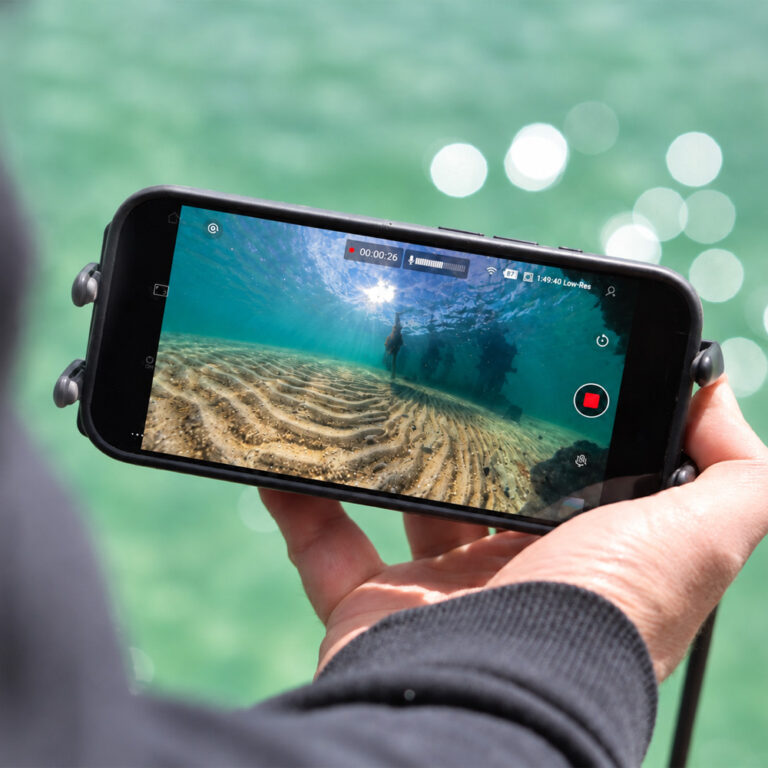
If you shoot with an Action 6 today, two Seavu systems already pair with it. The Seeker Marine Kit runs the camera on a cable from a boat, jetty or shoreline and sends a live feed to your phone or tablet. The Explorer Adventure Kit puts the camera in a sealed housing on a 17m hand reel or a 27m cable reel, which suits fishing, drop camera work and inspections. Both also work with the Action 5 Pro, Action 4, Action 3, Action 2 and the original Osmo Action, so the kit outlasts the camera. We covered the setup in more detail in DJI Action 6 underwater live view.
How deep you can work comes down to two things: how far the cable runs, and how deep the housing is rated. Seeker Marine cable options run 3m, 7m, 17m, 27m and 52m, so the longest gives you 52m of reach between you and the camera. The Explorer housing is rated IPX8 to 50m. The 52m cable suits a narrower set of cameras, so check the compatibility list before ordering.
Whatever DJI ships next, one limit carries straight over. WiFi and Bluetooth do not travel through water, so no action camera can stream a live view once it is submerged. That is physics rather than firmware, so a bigger sensor and a faster processor will not fix it. The Action 7 will launch with the same blind spot as every action camera before it.
This is the gap a Seavu system closes. A sealed cable carries the signal from the camera to the surface, so you watch the live feed on your phone or tablet while the camera films below. You frame the shot, check visibility and see what is actually down there as it happens, instead of pulling the camera up to find out.
Expected price
Pricing also remains unconfirmed. Still, early estimates suggest a standard combo around 349 to 429 US dollars and an Adventure combo around 479 to 579 US dollars. That would mark a small increase over the Osmo Action 6, which launched at 329 to 429 US dollars depending on the bundle. As with the Action 6, availability may vary by region, so US buyers should watch official channels closely given DJI’s recent supply situation there.
How the Osmo Action 7 could compare to rivals
The Action 7 is not the only next generation flagship on the horizon. GoPro is also preparing the HERO14, which rumours tie to 8K video and a new processor. Meanwhile, Insta360’s Ace Pro 2 already shoots 8K at 30fps, so DJI is really answering the whole field rather than a single rival. Still, keep some perspective: DJI already matches most of what its rivals now market, often at a lower price, so an 8K headline number is not the whole story.
The key difference right now comes down to momentum. DJI has a clear and recent release history, whereas the HERO14 keeps slipping with no confirmed date. If both arrive in late 2026 as some expect, it could become one of the most interesting action camera face offs in years.
For more on the GoPro side, see our GoPro HERO14 rumours and release date guide, and our GoPro HERO14 vs DJI Osmo Action 6 comparison.
Should you wait for the Action 7 or buy now?
If you already own a working action camera, waiting to see what DJI announces may pay off, especially if 8K and stronger low light performance matter to you. However, a late 2026 launch remains a rumour, and the Osmo Action 6 already performs superbly underwater and ships today in most regions. So for many users, there is little reason to wait.
To see what the current model offers, read our DJI Osmo Action 6 guide, or explore how live underwater viewing works with a compatible action camera.
Bottom line
Overall, the DJI Osmo Action 7 is shaping up as a meaningful upgrade, with 8K video, better low light and smarter AI processing all rumoured. A late 2026 release looks most likely given DJI’s history, though nothing is confirmed and the specs could still change before launch. For underwater users, the improvements worth watching are low light, dynamic range and battery life. Whichever camera you choose, a Seavu system lets you see your footage live while it films below the surface.
Expected release: Late 2026, not officially confirmed
Rumoured upgrades: 8K at 60fps, 4K at 240fps, up to 15 stops of dynamic range, RockSteady 4.0, AI low light optimisation, longer battery life